
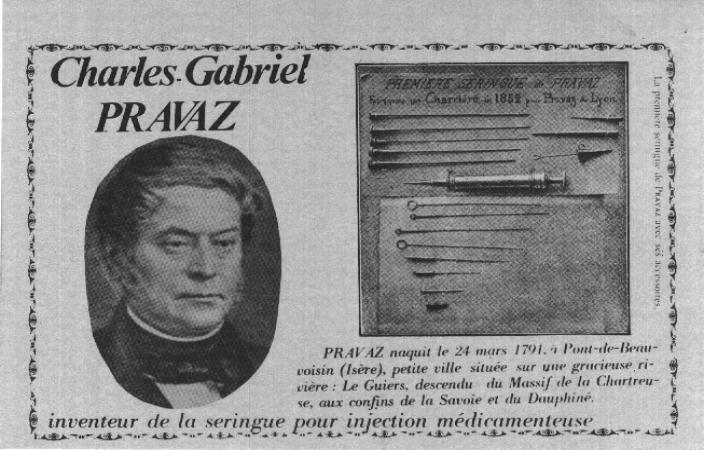
The concept of a syringe was not new. Galen had used one to inject blood vessels of the brain. But use of syringes relied on either the natural openings of the body or an initial cutting open of the skin. Progress awaited the innovations of Francis Rynd, Charles Pravaz and Alexander Wood.In 1844, Irish physician Francis Rynd (1811-1861) invented the hollow needle. In 1853, French physician Charles Pravaz developed the first practical metal syringe. Pravaz added a fine, hollow needle to the end of his syringe instead of the tube. This was an important innovation. Yet in the pre-antiseptic era it was a mixed blessing. The use of injections rather than oral drug administration can more readily promote the spread of disease as well as facilitating its cure. An understanding of the germ theory of disease - and the cardinal importance of using sterile needles - awaited the discoveries of Lister, Pasteur and Koch. But intravenous injection allows extremely rapid pain-relief - and the induction of general anaesthesia when suitable agents were developed.
Pravaz used his syringe for intra-arterial injection in the treatment of aneurysm. Wood used his syringe for management of neuralgic pains.